
Suspension and Steering Repair Doylestown, PA
Expert Suspension, Steering, and Wheel Services for Doylestown Drivers
Suspension and steering repair in Doylestown, PA, covers the connected systems that keep your tires planted, your steering true, and your ride controlled. This includes shocks and struts, wheel alignment, tie rods, control arm bushings, and wheel balancing on domestic, Asian, and European vehicles.
Epoch Automotive uses on-site Hunter alignment equipment to measure camber angle, caster angle, toe adjustment, and thrust angle against OEM alignment specifications on every job.
Frost heaves, potholes, and rough winter roads across Bucks County beat up suspension components in ways a mild-climate shop never sees. Qualifying repairs are backed by a warranty. Digital Vehicle Inspections with photo documentation are also sent to your phone, so you can see the worn tie rod end or leaking strut before any work is approved.
Suspension, Steering, and Wheel Services
The suspension, steering, and wheel systems work together as one connected system. A worn control arm bushing changes alignment geometry, a leaking strut accelerates tire cupping, and an out-of-balance wheel loads the tie rod end unevenly.
Doylestown’s pothole-scarred township roads and higher-speed stretches of Route 611 and Route 202 stress these components in different ways. That is why we diagnose every complaint as a system rather than focusing on a single part.
Shocks and Struts
Blown or leaking shocks and struts show up as excessive body roll, nose-dive under braking, or a bouncy ride after crossing a frost heave on North Main or Easton Road. We road test, inspect for fluid weeping and worn mounts, and provide a quote for replacement with OEM-spec dampers. See the shocks and struts page for the full replacement scope and inspection details.
Wheel Alignment
An off-center steering wheel, pulling to one side, and uneven tire wear can indicate that the alignment is outside factory tolerance. This often happens after a hard pothole strike on a winter-damaged stretch of road. Our Hunter alignment machine measures camber, caster, toe, and thrust angle before adjusting to OEM alignment specifications. See the wheel alignment page for the full alignment service details and tire wear inspection.
Wheel Balancing
Wheel balancing corrects the weight distribution of the tire and wheel assembly so it rotates without producing a vibration you feel in the steering wheel or seat.
The most common symptom is a smooth ride below 50 mph that turns into a rhythmic shake between 55 and 70 mph. The vibration is typically felt on Route 611 or the PA Turnpike on the way toward Willow Grove. The cause is usually thrown wheel weight or tire wear that has become uneven from a previous alignment issue. It can also result from a wheel that was not rebalanced after a tire repair.
Doylestown’s pothole-heavy winters accelerate this because a hard impact can knock a weight loose without leaving a visible mark. We mount each wheel on a Hunter tire machine, measure static and dynamic imbalance, and apply corrective weights until each assembly is within specification. If the imbalance traces to internal tire damage rather than a lost weight, we identify that during the measurement rather than after you leave.
Suspension and Steering Repair (Tie Rods, Ball Joints, Control Arms)
Clunking over expansion joints, loose steering feel, and uneven inner or outer tire wear typically trace back to worn tie rod ends, ball joints, or control arm bushings. These symptoms are often caused by those components rather than the shocks themselves. The underlying cause is the constant flexing these joints endure whenever a wheel drops into a pothole or crosses a frost heave. That is common on Bucks County secondary roads through Warrington and Chalfont during winter.
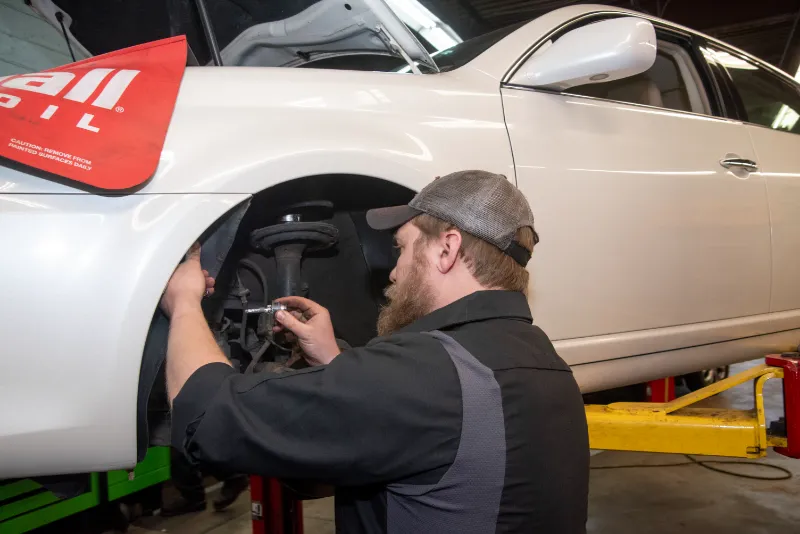
On a road test, we listen for the specific noise and identify which corner it comes from. Then, we performed dry-park tests on each joint and pry-checked the bushings on the lift to isolate the failed part.
Because these components directly control alignment geometry, we always follow up with an alignment after replacing a tie rod end or control arm. We use the Hunter machine to reset toe and camber to OEM specifications. The repair path is component-specific. It may involve pressed control arm bushings or complete control arm assemblies when the bushing is not serviceable. Other repairs may include tie rod end replacement with a torque-to-spec install or ball joint replacement, depending on which joint failed the test.
Power Steering Repair
Heavy steering effort, whining noises during turns, or a low fluid level in the reservoir can point to a power steering issue. This applies whether the system is hydraulic or electric power-assisted (EPS). On hydraulic systems, the usual causes are pump wear, a leaking rack and pinion, or degraded fluid. On EPS systems, the failure is typically the electric assist motor, torque sensor, or a fault code in the steering control module.
New Hope and Chalfont drivers who spend time on twisting secondary roads notice the problem earlier than highway commuters because the system is under load more often.
Diagnosis starts with a scan for stored steering-related codes, a fluid condition check on hydraulic systems, and a pressure test if a leak is suspected. The repair path depends on the finding. It may involve rack and pinion replacement, pump replacement with a fluid flush, or hose replacement for a pressurized leak. On EPS systems, repairs may include motor or sensor replacement followed by a steering angle sensor calibration.
Suspension, Steering, and Wheel Noise, Vibration, and Diagnostic Concerns
Steering Wheel Vibration at Highway Speed
A vibration that starts between 55 and 70 mph and disappears when you slow down is usually related to the wheels or tires. Common causes include a wheel balance issue, a bent wheel from a pothole strike, or internal tire damage from that impact. Doylestown’s winter road surfaces produce the exact impacts that throw weights and bend rims. See the wheel alignment page if the vibration is paired with a pull or off-center steering wheel.
Pulling to One Side or Off-Center Steering Wheel
A car that drifts right on a level road can indicate an alignment issue. A steering wheel that sits crooked when you are driving straight can also mean the alignment has moved outside factory tolerance. The typical cause is a pothole strike or a worn steering or suspension component that has shifted toe or camber. If the pull is paired with uneven tire wear, the tire condition also needs to be evaluated alongside the alignment.
Clunking or Knocking Over Bumps
A clunk over expansion joints or a knock when turning into a driveway usually points to a worn sway bar link, a failing strut mount, or a loose ball joint. These symptoms are often caused by those components rather than the strut itself. These parts fail progressively, and the noise gets sharper as clearance in the joint grows.
Uneven or Rapid Tire Wear
Inner-edge feathering, outer-shoulder wear, or cupping across the tread all tell a different story about what is wrong underneath. Cupping points to worn dampers; inner or outer edge wear points to a toe or camber issue; patchy wear points to imbalance. Tire wear is often the first visible evidence of a suspension or alignment problem that has been developing for months.
Concerned about these symptoms?
How We Approach Suspension, Steering, and Wheel Service
Every suspension or steering complaint starts with a documented road test to confirm the symptom. This is followed by a lift inspection with dry-park steering checks and pry-checks of bushings and joints. We also take a Hunter alignment reading to see where the geometry actually sits.
When a symptom points to imbalance or a bent wheel, the wheel goes on the Hunter tire machine for measurement. This gives us an accurate reading rather than relying on the road test alone.
Findings are provided through a Digital Vehicle Inspection with photos. These can show the worn tie rod end, leaking strut, or alignment printout showing where toe and camber compare with OEM alignment specifications. Nothing is ordered or installed until you approve a written estimate. After any component replacement that affects geometry, a follow-up alignment resets the vehicle to spec so the new parts wear at the correct rate.
More Services
Suspension and Steering Repair
Suspension and steering repairs improve handling and driving stability.
What Sets Epoch Automotive Apart for Suspension, Steering, and Wheel Services
We use our Hunter alignment machine and Hunter tire machine for measured diagnostics instead of relying on visual estimates.
We use OEM-spec parts as the standard for every suspension and steering job.
Our Digital Vehicle Inspections include photo documentation sent directly to your phone.
Qualifying repairs are backed by warranty coverage that is honored across our Doylestown service area.
Loaner cars and courtesy shuttles are available for extended repairs, helping keep your week on schedule.
Our Promise to You
We measure before we recommend, using alignment readings and joint tests to support every repair line.
We provide written estimates with findings sent directly to your phone before any work is approved.
No repair proceeds without your explicit sign-off, and we explain the findings in plain language first.
Automated service follow-ups help keep alignment checks and rebalancing on schedule.
We focus on relationship-based service and goal-oriented maintenance plans, so a $200 alignment does not turn into a $2,000 tire replacement six months later.
For related work, see the brake repair and safety inspection and preventive maintenance pages.
Frequently Asked Questions About Suspension, Steering, and Wheel Services in Doylestown
Will having suspension, steering, and wheel services work done at an independent shop void my vehicle's warranty?
No. The Magnuson-Moss Warranty Act prohibits manufacturers from voiding your vehicle warranty simply because you chose an independent repair shop over the dealership.
Epoch Automotive uses OEM-spec parts and manufacturer-level diagnostic procedures for suspension, steering, and wheel services, which meets the standard required to maintain your warranty coverage. Keep your service records, and you are protected.
How often should I get a wheel alignment?
Most manufacturers recommend an alignment check every 12,000 to 15,000 miles or once a year, whichever comes first. In Bucks County, winter frost heaves and potholes can routinely knock alignment out of spec. We recommend an alignment check any time you notice a pull, off-center steering wheel, or uneven tire wear, regardless of mileage.
What are the signs my car needs an alignment?
The most common signs include the vehicle pulling to one side on a level road and a steering wheel that sits off-center when driving straight. Uneven tire wear on the inner or outer edges and loose or wandering steering are also common signs. Any one of these warrants an alignment check before tire wear becomes irreversible.
How long does a wheel alignment take?
A standard four-wheel alignment on our Hunter machine takes about 60 to 90 minutes when no component replacement is needed. If a worn tie rod end or control arm bushing is found during the pre-alignment inspection, that component is replaced first. The alignment is performed afterward, which extends the total service time.
Schedule Your Suspension, Steering, and Wheel Service in Doylestown Today
If your steering wheel sits off-center, your tires are wearing unevenly, or you feel a vibration at highway speed, Epoch Automotive can help identify the cause. We use a Hunter alignment reading and full chassis inspection to determine what is out of spec before any parts are ordered.
Qualifying repairs are backed by our warranty. Loaner cars are also available if the work takes more than a day. Schedule your inspection today.
Epoch Automotive | 243 Harvey Ave Ste 102, Doylestown, PA 18901 | (267) 406-4922